|
New Zealand
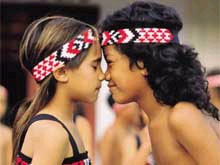
Rangi is a Maori tattooist who is tattooing a Westerner at his shop. Rangi has a deep interest in his family genealogy and he mentions the 12 main tribes of New Zealand that arrived at slightly different times to New Zealand. Rangi was from the Paikea canoe (Whale rider) which landed near Gisbon 50 generations ago. Their canoe was wrecked before it reached the shore and a whale rescued them. Rangi’s family shows us the carvings and tattoos that represent their arrival in New Zealand as well as their traditional tattooing equipment. Rangi tells a legend of tattooing coming with their ancestors from Hawai’i to Rarotonga (Sun in the South). We fly 3,000km to Rarotonga (Cook Islands) where Rangi meets up with people of his ancestral lineage. We are welcomed with a Hangi feast (roast pig in earth oven), sweet potato or Kumera and a native pineapple. They mention that these items were brought to Rarotonga from an ancestral homeland in the East.
Rarotonga people show us ancient ruins associated with the ‘Children of the Sun’ including the harbour where boats would leave to go to New Zealand following a migratory path of the red parrot. The ancient cobblestone road around the island and other ruins suggests that a highly organized society once lived there. We follow this trail and meet up with tattooists in Tahiti who tell us the legend of the voyage of Hokulea arriving in Tahiti – ‘the distant land’.
From Hawaii and beyond to Canada we find the lost art of tattooing being revived. We find traditional tattooing equipment in a museum very similar to Polynesian equipment.
Although the Tlingit are the closest relatives to Polynesians, the Pima of California and Maya of Mexico are also closely related, arriving from Taiwan somewhere between 6,000 and 8,000 years ago. These people also brought the art of tattooing from East Asia and of course created new signature designs to identify their new reinvented culture in their new homeland. Our Tattooist examines Mayan tattoo designs.
The final branch of this Tattoo culture we look at are the Pict warriors of Scotland. Our Tattooist inspects designs associated with the Picts and is amazed how similar the swirls are to Maori designs. How did the Asian art of tattooing arrive in Scotland? It appears that the name Pict was merely the Latin name given to these people by the Romans, their real name was the Caledonians. The possibility that the Caledonians came from a tribe of Caucasians known as the Mexican Lancandones becomes even more real when we find that these people were once a part of the tattooed Mayan culture. The European war god Woden or Odin was known as Votan by the Mayans.
Rangi sits amongst the Lancandones and is welcomed in like a long lost relative. They sit down to a meal of Kumera – using exactly the same species as what is found in the Pacific
|