|
Samoa
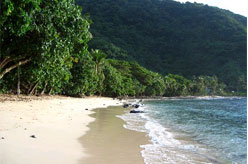
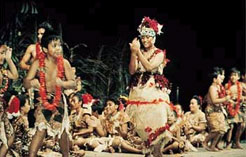
The idyllic islands of Samoa are pictured with coconut tree lined beaches. In the streets of a village, everyone is colourfully clothed and off to church. Round ended houses, look much like Mayan houses, there are people picking cocoa and eating it with chilli. This morphs into a village scene from the past that almost looks like a scene from Central America. There is a pyramid in the background in the bay, a 30 metre outrigger sailing canoe is approaching the shore, it is decorated with putrid skulls and there is a diverse mix of racial groups, tall red heads, Melanesians and Polynesians.
Jane Resture shows us the bay of putrefaction of men. We look at the remains of a pyramid, now only a pile of rubble. She says that the name of the bay and the pyramid was from a previous group of people called “The ‘Children of Batuku-the-Skull.’ They would practice human sacrifice on a grand scale, plundering islands for the heads of the first-born and bald or bearded heads of wise men – the brains of which they would eat. The Batuku people were called the Red Men. They were fair skinned with red hair, very tall with unusually long skulls. Their culture extended as far as Tahiti, they even tried to invade Hawaii. Then in the 13th century, a Samoan Chief Savea had enough of his people being eaten and decided to end the reign of these barbarians. He destroyed the Batuku skull culture in Samoa, news of this victory spread and within 200 years this culture was destroyed throughout the Pacific, resulting in a reinstatement of the friendly ‘Hawaiian style’ culture that the first European sailors experienced upon their arrival in Tahiti.
Jane takes us to Misima Island in Papua New Guinea where betel nut chewing, red heads, still exist. We go to Vanuatu and see long skulls in burial urns. From Misima island we fly 2,500 km to the Teouma archaeological site in Vanuatu and view the unusually shaped skulls in burial urns. A comparison is made with burial urns of Tamil Nadu and Harappa. Archaeological evidence shows no evidence of a formative phase in Melanesia, but does show devolution of design, suggesting that these people assimilated into Melanesian culture through time.
A geneticist, compares the DNA of the Burial urns to the red and blond haired Misima and Tolai people of Melanesia and finds that there is a perfect match. The rare haplotype; HLA A11,B40, connects Melanesians to both the Indus region and Tamil Nadu. Is it possible that these people were part of a great exodus out of India in 1,500BC? The genetic evidence shows that Polynesians only encountered Melanesians and this society less than 1,000 years ago. Hawaiian society did not experience these people until less than 800 years ago
|