|
The Mysteries of Tango
Episode 1: The birth of the tango song
The birth of the songs in Tango was influenced by different factors: singers started to incorporate the theme of the "lost love" in their songs, the arrivals of hundreds of thousands of migrants to Buenos Aires, the boom of brothels and “My sad night”, a Tango song written by Carlos Gardel and considered the first one.
Episode 2: The myth of Gardel
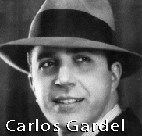
Carlos Gardel is considered the greatest Tango singer of all times. The theories on his different nationalities. Who was his father? The mystery of the bullet in his lungs. Was he jailed when young? The reasons for the plane accident that killed him. The manipulation of the masses in his funeral.
Episode 3: Tango, the music of the brothels
The new dance in the brothels of the end of the 19th and early 20th centuries. How the tango becomes part of the “waiting” halls of the brothels. How the men dance with each other so they can practice and attract the most beautiful prostitutes. The lyrics with sexual innuendos of the songs.
Episode 4: The sound of the orchestras
The style and secrets of the most important Tango players such as Troilo, Pugliese, D'Arienzo, De Caro, De Angelis, Di Sarli, Gobbi, Salgán. The “maestros” and their respective orchestras and what elements were they emphasizing to make their styles different from the others.
Episode 5: The technique of the Tango
The teaching of the steps of Tango as taught in the 30’s, 40’s and 50’s and how is it taught today. The great dancers: Copes, Virulazo, Cachafaz, Zotto. How the famous steps were born. How does a couple practices different styles of Tango. The “Milonga”, the secrets of the Tango dance.
Episode 6: Tango and politics
How the lyrics and music of Tango expressed the political reality of Argentina. The relationship between the political power and the singers who opposed the regime. How the class struggle was incorporated in the lyrics of well known singers.
Episode 7: Tango y poetry
The lyrics of the Tango of the 40’sand 50’s. What sort of society they described? What was their vision? The melancholy of Manzi. The sharp criticism of Discépolo. The night life Cadícamo. Homero Expósito and his surrealistic metaphor.
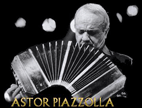
Episode 8: The revolution of Piazzolla
His musical academic upbringing in contrast to the Tango being ‘taught’ in cabaret. The structural difference of his music with the traditional one. His self discovery in his trip to Paris in 1955. His struggle against the establishment in the world of Tango in Argentina. His international success.
Episode 9: The international success of Tango
How Argentineans performances such as Tango Argentino conquered Broadway. The Sexteto Mayor, ambassadors of Tango n 100 cities around the world always return to their suburb. Miguel Zotto: the stylist of the modernism in Tango and his passion for the Milonga of Buenos Aires.
Episode 10: The testament of Piazzolla
The urban style Daniel Binelli, the brainy approach and his will to return to the sources of Tango of Rodolfo Mederos, the influence of jazz in the Tango of Néstor Marconi, the modern interpretations of Marcelo Nisiman and Gustavo Toker. Piazzolla as the benchmark in modern Tango.
|